If you’ve been looking for the best AI tools for research writing in 2026 — you’ve probably just spent an evening staring at a blank document trying to figure out where to even start your literature review.
A postgraduate student I know spent nearly a month writing her first research paper a few years back. Preparing the outline, gathering relevant sources, citing everything properly, paraphrasing carefully to avoid plagiarism, then two or three full rounds of editing. It was genuinely exhausting work. When she started her second paper recently using proper AI tools, the entire process took about a week instead. Same effort on the actual thinking, dramatically less time lost to the mechanical parts.
I went through the best AI tools for research writing that genuinely help with academic work — not by writing your paper for you, but by handling the repetitive parts so you can focus on the actual research. Here’s what each one does well, and an honest note on where the ethical line sits.
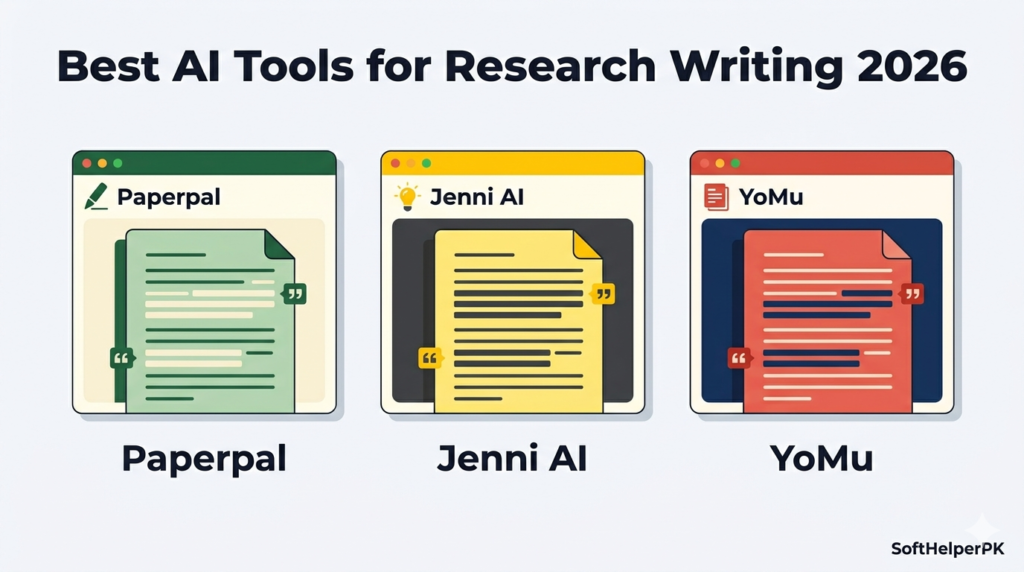
1. Paperpal — Best for Cross-Platform Flexibility and Journal Checks
Free tier available with premium features.
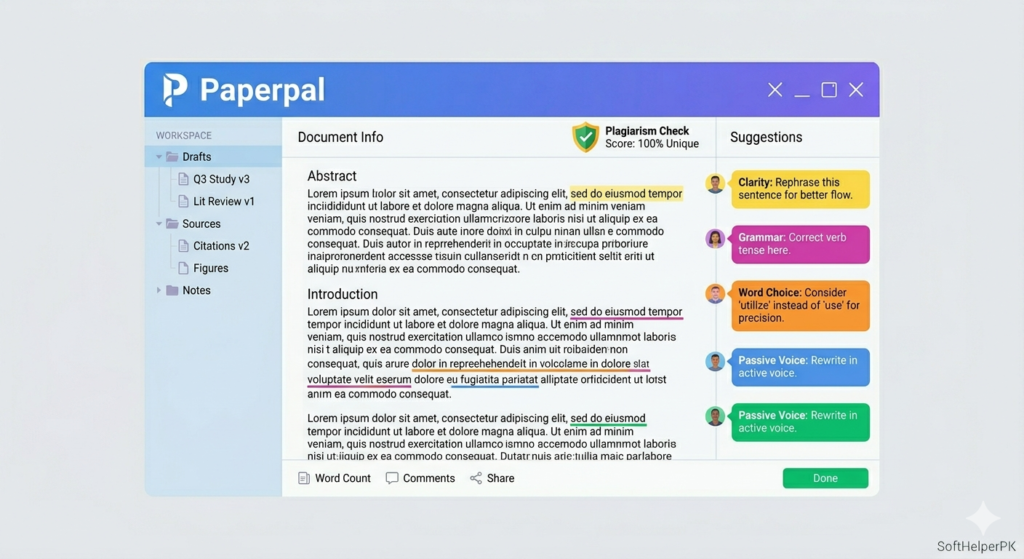
Paperpal’s biggest strength is that it works wherever you’re already writing — Google Docs, Microsoft Word, or even LaTeX, rather than locking you into one specific platform. If your university or supervisor has a preferred writing environment, Paperpal fits into it rather than forcing you to switch.
The plagiarism check is genuinely thorough, identifying accidental overlaps with existing published work so you can catch problems before submission rather than after a journal flags them. The journal check feature goes further still, running your draft against multiple submission criteria to help you fix gaps before sending it to a supervisor or journal — things like missing sections or formatting issues that often get overlooked until it’s too late.
Beyond that, there’s an AI review feature giving feedback on overall writing quality, plus built-in templates for things like cover letters and emails to journals, which sounds minor but genuinely saves time when you’re juggling submission deadlines. Among the best AI tools for research writing, Paperpal stands out specifically for researchers who need flexibility across different writing platforms.
2. Jenni AI — Best for All-in-One Literature Management
Free tier available with usage limits.
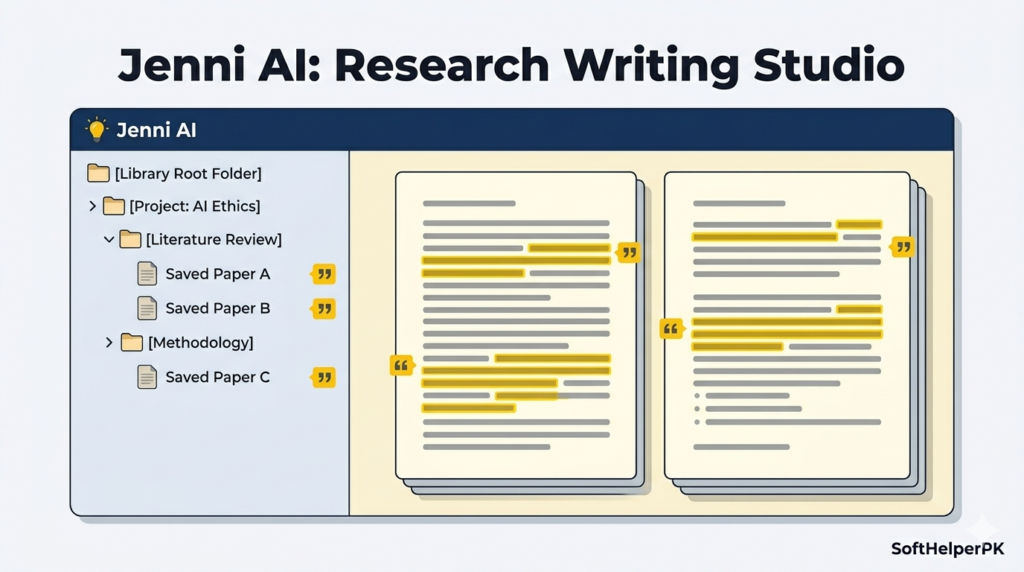
Jenni’s standout feature is its library system — you can upload all your literature directly onto the platform, organise it neatly into folders, access it while writing, and cite sources on the go without switching between tabs or applications. For anyone juggling dozens of sources across a long research project, having everything genuinely in one place is a significant time saver.
It also includes an AI chat assistant for research questions, automatic outline generation when you open a new document, sentence-level autocomplete suggestions as you type, and a cite-while-you-write feature that searches the internet for relevant content based on what you’ve already written and cites it simultaneously. That last part pushes it a step beyond standard reference managers like Zotero or Mendeley, which only let you cite from your existing library rather than actively discovering new relevant sources as you write.
For literature review, drafting, reference management, and polishing all genuinely happening in one place without tab-switching, Jenni AI is one of the best AI tools for research writing specifically for researchers managing large amounts of source material.
3. YoMu — Best for Contextual Writing Feedback
Free tier available with usage limits.
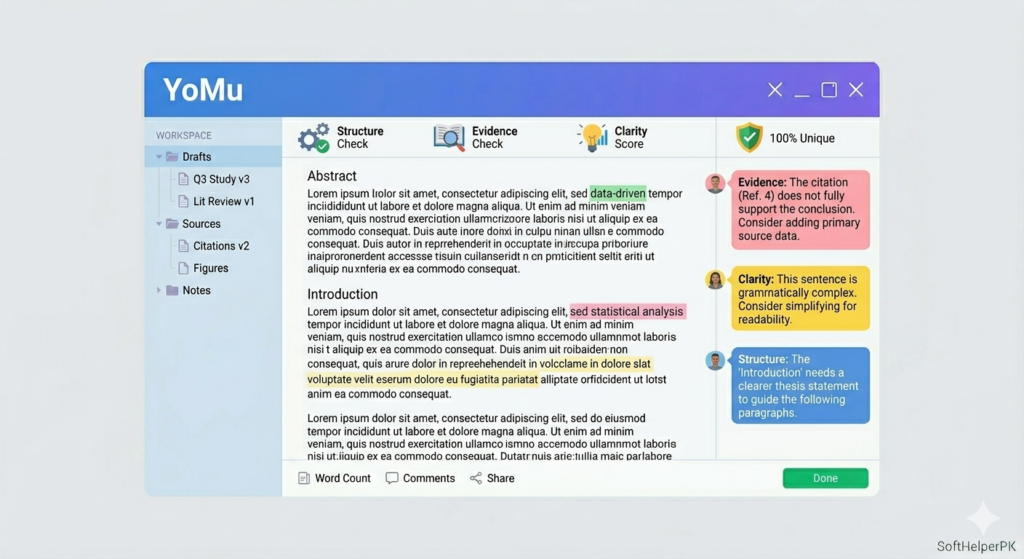
YoMu’s standout feature is feedback that goes well beyond fixing grammar. It functions almost like showing your draft to a senior researcher or supervisor — telling you whether you’ve included enough evidence to support your claims, whether your sections are structured properly, or whether you need more examples to strengthen an argument. That kind of contextual assessment is genuinely harder to get without waiting for human feedback, and getting it earlier in the process means fewer surprises during supervisor review.
It also includes the same core features found across all three tools on this list — a chat assistant under its “Chat with YoMu” option, automatic outline generation for research papers or proposals, sentence-level autocomplete with full control over whether you accept each suggestion, and a chat-with-PDF feature for getting instant help when you’re stuck on understanding a source.
For researchers who specifically want feedback on argument strength and structure rather than just language polish, YoMu is consistently one of the best AI tools for research writing for that deeper layer of review.
👉 Try YoMu
Important — Using AI in Academic Writing Responsibly
This matters enough to address directly. Using AI tools in academic writing is generally accepted, but only within clear limits.
The core parts of your research — your ideas, your methods, your results, your interpretation — need to remain entirely your own work. That’s your actual intellectual contribution, and it genuinely cannot come from an AI tool. Use these tools to polish language, improve clarity, check grammar, and suggest structure. Don’t use them to generate your actual findings or analysis.
Most journals now require disclosure of AI tool use, typically in either the methods section or the acknowledgements, where you note the specific tool and version used. AI should never be listed as an author — you, as the human researcher, remain fully responsible for everything submitted under your name. Journals generally don’t use AI detection or “humanising” text as submission criteria, so that specific worry isn’t usually the issue — the actual requirement is honest disclosure and keeping the intellectual work genuinely your own.
Which One Should You Actually Use?
Depends on what’s slowing you down most in your writing process.
If you need flexibility across Word, Google Docs, or LaTeX and want strong plagiarism and journal checks — Paperpal.
If you’re managing a large amount of literature and want everything in one organised place — Jenni AI.
If you want deeper feedback on argument strength and structure, not just language — YoMu.
These best AI tools for research writing all share the same core features — chat assistance, outline generation, language improvement, and cite-while-you-write — so the right choice really comes down to which extra strength matters most for your specific project.
One practical tip — write your actual ideas, arguments, and findings yourself first, then bring in the AI tool afterward purely to refine language and structure. Writing the substance yourself first, then polishing second, keeps the intellectual work genuinely yours while still saving significant time on the mechanical parts of academic writing.
If you’re also exploring AI tools beyond research writing specifically, check out my guide on how to use AI for students free in 2026 — covers a broader range of tools for everyday studying alongside research-specific work.
This article was researched and written with the assistance of AI tools and reviewed by Muhammad Usama.